
Summary
Whenever I run a release demo, I try to start from the customer’s point of view before I get to what we built. Our Chief Product Officer Neil Weldon did the same in his post recently on the four areas of Agentic Assurance, and I want to follow that thread from the product side further. Looking at it from the customer POV makes one thing clear: the AI voice agent you tested last month has probably changed since then.
This October just gone I joined a call with the voice team at a global workforce software company. They release changes to their AI voice agent roughly every two weeks, adding new tools and new behaviors each time. Their knowledge base sits in their CRM and feeds the agent through a search layer. Their routing team, CX team and AI team each own a different piece. Every one of those teams makes small, sensible changes, and the caller hears all of them at once.
As our CTO Satish said at launch, a single update to a model or knowledge base can change an agent’s behavior overnight. Model providers move on their own schedule too. OpenAI is retiring two older ChatGPT voice modes on December 11th and moving users to its newer GPT-Live model. That's the pace your release process has to keep up with.
So I think about AI voice agents the same way we think about our own platform releases at Klearcom. Every change needs to be trained for, tested, watched and tested again. Here is how that loop works with Klearcom.
Train them before launch
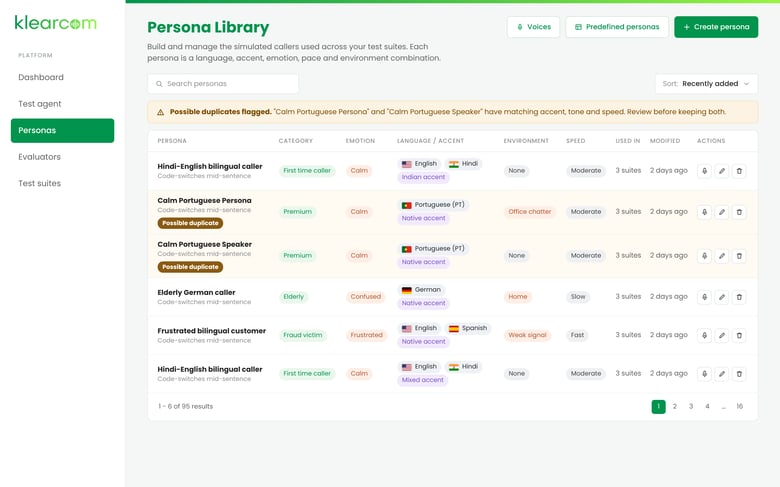
Before an agent goes anywhere near a real customer, our AI personas call it the way real people do: strong regional accents, a television in the background, a caller who interrupts halfway through a sentence or gives details in the wrong order. We vary 100+ variables across 20+ languages.
This matters more than most teams expect. A benchmark covered by CMSWire found that voice agents completed between 31 and 51 percent of 278 simulated customer service tasks in clean conditions, falling to between 26 and 38 percent once noise and diverse accents were added. Same agents, same tasks, very different results.
Take a bank. One persona calls in calm US English to report a lost card. Another calls in Spanish from a busy street and cuts the agent off to say someone may have used it. In both cases the agent should block the card and verify the caller before sharing anything. If it handles the first call and fails the second, you want to find out now, while the fix is still cheap.
Test them on every call
Once the agent is live, every call becomes a test. We check three things.
First, what the caller asked, and whether the agent understood the intent.
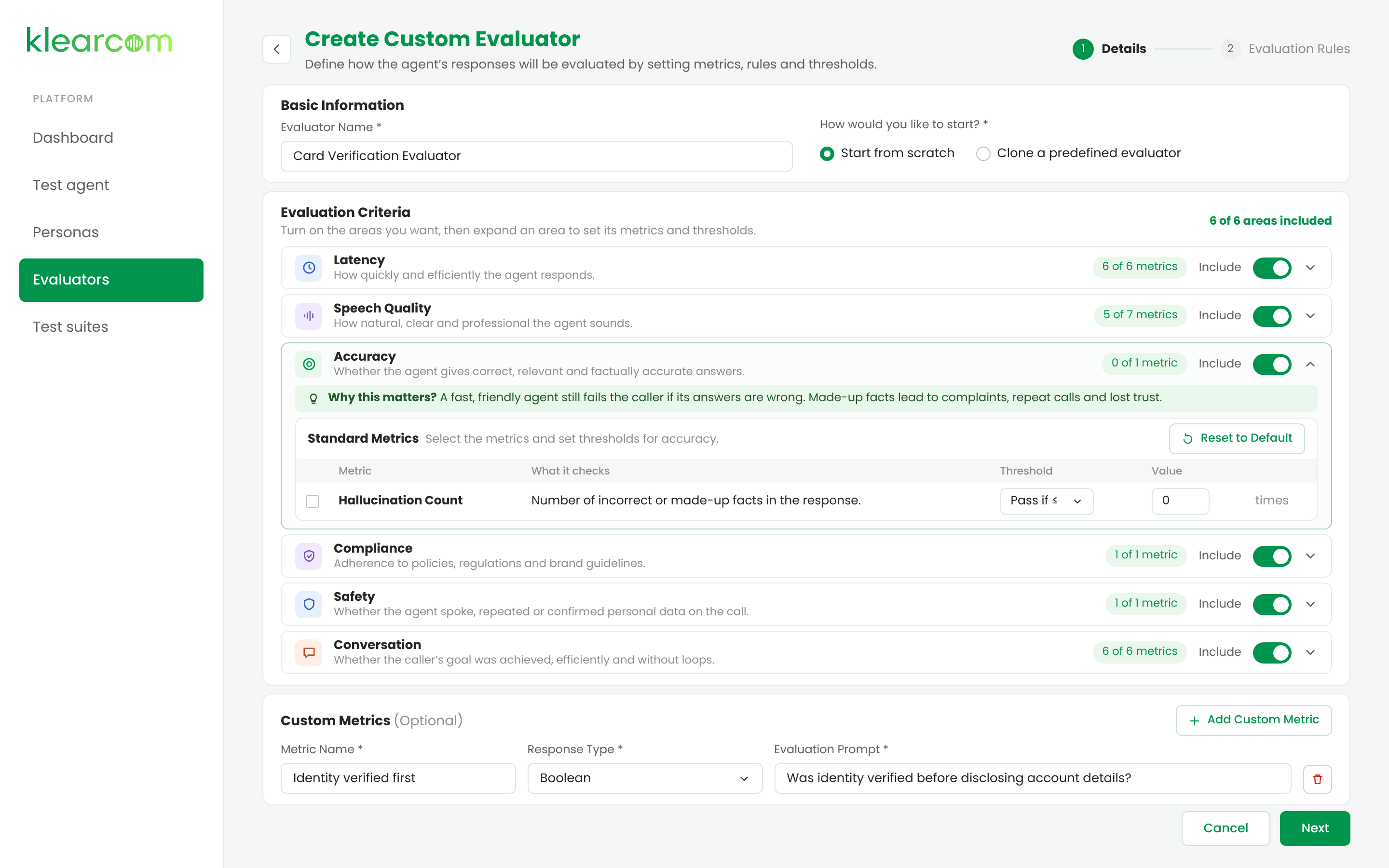
Second, what the agent said. Was it accurate, was it fast enough, did it follow policy? Accuracy is where the headlines come from. NBC Chicago reported on a traveler whose airline chatbot gave her the wrong terms on a travel credit. The airline admitted its chatbot had given her wrong information, but told her the credit could not be extended.
Third, what the agent actually did in your systems. On that October call, this is what their AI lead cared about most: after the agent creates a case, is the record filled in correctly? A transcript can read perfectly while the case, the refund or the callback never happens.
We report all of it by market and by carrier, because the same agent can behave differently in Germany than in Brazil.
Manage them live, in every market
The same checks keep running around the clock from inside each market. We place real calls from every country and over 340+ carriers, down the actual phone line. A lab shows you the agent as it was built. A real call placed in-country shows you the agent as your customers hear it, network and carrier included.
That team had already seen why. At one point their agent hit API limits on both the AI platform and the CRM, and calls behaved in ways nobody had planned for. They had also seen dead air on the handoff into the agent. Both are the kind of failure that only appears on a live call.
When something drifts, results reach your team as tickets and alerts, so the people who own the fix see it quickly.
Close the loop
Every model, prompt, knowledge or route change triggers a retest. The suites you trained with before launch run again automatically against the new version.
The pass and fail criteria are set by your business. During that October demo, our test caller asked for a case update and the agent passed it straight to a human. We checked whether that was right, and their team confirmed it: the caller was not listed on the case, so a handoff was the expected behavior. They also told us payments and certain accounts must always go to a person. Those are their rules, so those are the rules we score against.
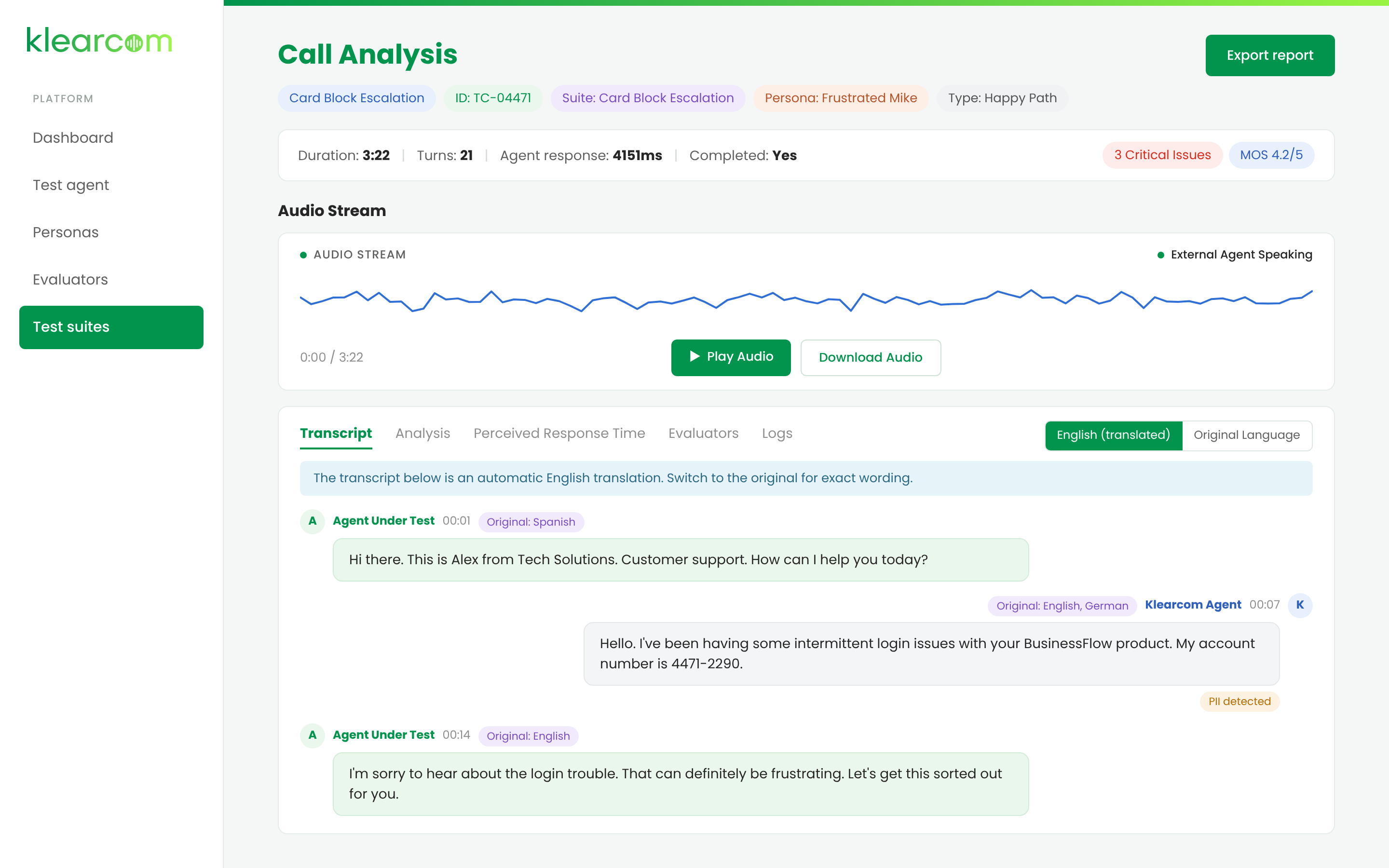
Critical errors become hard fails. In the same demo, one call scored well overall, yet our analysis flagged that the agent shared a case status before finishing identity verification. A hard fail rule stops a release on that alone, whatever the average says.
The industry is learning this the hard way. ITPro reported on Sinch research showing that 74% of companies had shut down or rolled back an AI agent in customer service because of governance failures, and the rate rose to 81% among those with mature guardrails, possibly because better monitoring spots failures that would otherwise go unseen. Finding problems is the point. Finding them before your customers do is the goal.
Evidence, release by release
Every run is recorded: what was tested, when, against which version and what passed. A global payments company we demoed to in August asked early on how we encrypt and store test data, because evidence is only useful if it is handled properly too.
Regulators are moving the same way. California’s Right to Human Customer Service Act requires large businesses to disclose when a customer is talking to a chatbot and to make a good faith effort to connect them with a person within 15 minutes of a request, with most of the new laws taking effect on January 1. In New York City, the consumer protection agency proposed a rule in October that would require automated systems to help in a reasonable and timely manner and stop answering with irrelevant or incorrect information, with a public hearing set for November 19.
When your board, an auditor or a regulator asks how you know your agent works, you need to show them.