
Summary: AI voice agents are the fourth great migration in the contact center, and they bring a fourth blind spot. The enterprise, carrier, CCaaS platform and AI provider each see only their own piece of the call. Klearcom’s AI voice agent testing calls from inside every market, proving agents work, pinpointing where they fail and checking compliance long after launch.
Four migrations, one constant
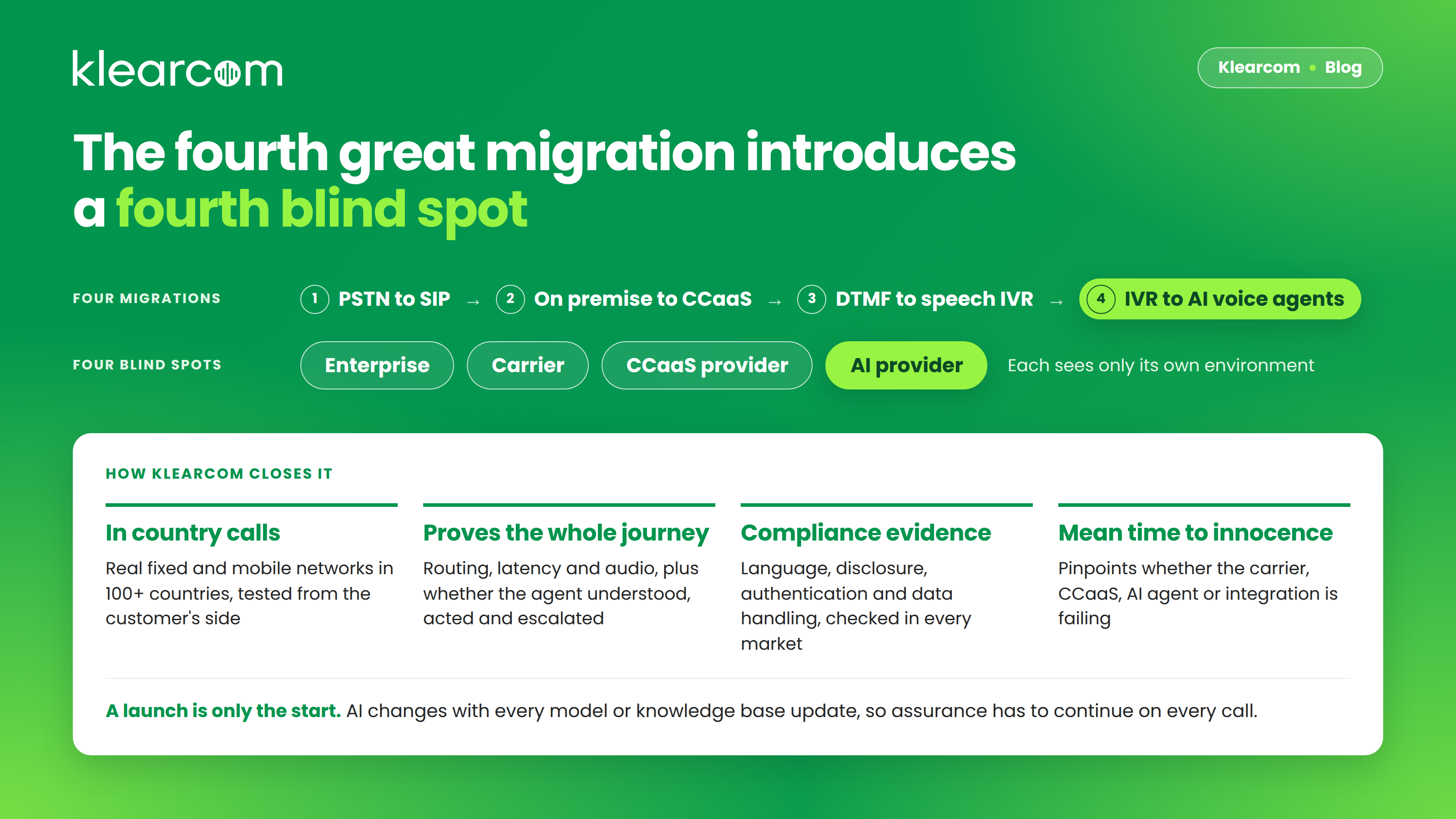
I have watched enterprises change how they talk to customers four times now, and Klearcom has been on the line for every one. PSTN moved to SIP. On premise contact centers moved to CCaaS. DTMF menus gave way to speech IVRs. Now IVRs are giving way to AI voice agents that hold a real conversation, take a payment and decide for themselves when a human should step in.
Every one of those moves was sold as progress, and rightly so. Every one also added another party to the call and another place for it to break unnoticed. The fourth great migration brings a fourth blind spot, and closing it with AI voice agent testing is why Klearcom belongs in this market.
Four parties, four partial views
Count the parties on a customer call today and you get four: the enterprise, the carrier, the CCaaS provider and the AI provider. Each sees its own environment in detail. Ultimately, none of them sees the call from the customer's phone.
It's like building a house with four different trades on site. The electrician signs off the wiring, the plumber signs off the pipes, and nobody runs the shower until the family moves in.
The route nobody sees
Take a customer in Germany calling a German number. That call can reach the carrier in Berlin, travel to Paris for the CCaaS platform, cross to Madrid where the AI voice agent runs, and return to Frankfurt where the enterprise checks the account.
Every hop adds latency and risk, and providers change routing without telling anyone. I have yet to meet an enterprise that can tell me which route a given call took on a given Tuesday.
So an AI voice agent that performs beautifully inside its supplier's platform has proved exactly that. The customer on a mobile in Munich, a landline in Osaka or a prepaid SIM in São Paulo is a different test, and somebody has to run it.
Why AI voice agent testing has to happen in-country
Justin Robbins of Metric Sherpa told CX Today recently that AI has become table stakes, yet too many contact center leaders still run old playbooks. The same piece reported that nine in ten service leaders are under executive pressure to deploy AI. The result: the agent is tested in a lab, signed off in the vendor's environment and switched on in thirty countries at once.
Thirty markets means thirty sets of carriers, accents and routing paths. Without independent calls starting inside each one, customers and local teams become the monitoring system, one complaint at a time.
This is the part of Klearcom I am proudest of. We place calls from inside more than 100 countries, over real fixed and mobile networks across 340+ carriers, so we hear the journey exactly as a local customer does.
That joins the telecoms layer (reachability, routing, latency, audio quality) to the conversation layer: did the agent understand, respond correctly, complete the action and hand over to a human when it should?
AI voice agent compliance happens on the call
Since August 2nd, Article 50 of the EU AI Act has required AI that talks directly with people to say so, as Al Jazeera reported, with fines up to 15 million euros or 3% of global turnover. Brussels delayed the high risk rules, but disclosure arrived on schedule, and the deploying enterprise is on the hook for it.
Across thirty markets, the agent must introduce itself in the right language, authenticate callers the way local rules expect and handle personal data the way each regime requires. A policy document records what the agent should do. A call from inside the market records what it did. That's the evidence we hand compliance, risk and audit teams.
Mean time to innocence
When the lights go out at home, you look out the window. If the neighbors are dark, it's the grid. If they are lit, you find the fuse box.
Contact centers rarely get that window. When an AI voice journey breaks, the carrier, the platform, the AI provider and the enterprise all check their own systems and find them healthy. Four green dashboards, one broken journey.
Klearcom has no stake in which link failed, and our calls start where the customer starts. We show which components are working, where the journey stopped and what the caller heard, so teams fix the right link fast. The innocent suppliers get to prove it.
A good launch is day one
An IVR is deterministic: press 2 on Monday or Friday and you land in the same place. An AI voice agent is probabilistic, and it shifts underneath you. One overnight edit to the knowledge base and the agent that told callers yesterday they had 30 days for a refund tells them 60 today. The line is up, latency is fine and nothing turns red. It's simply wrong, right in front of your customers.
That's why Klearcom is leading the charge to be the assurance layer for AI powered customer interactions globally. I will be straight: scoring a probabilistic conversation is harder than confirming a call flow, and we are working it out with our customers. What we already have is the hard part to copy: the global network underneath it.
From where your customers call
AI voice agents are the most capable technology ever put on a phone line, and they deserve to be judged on evidence before the complaints start.
The fourth great migration introduces a fourth blind spot. Klearcom independently tests AI voice agent conversations from inside the markets you serve, helping you prove they work and pinpoint where they fail, technically and against each market's regulatory and compliance requirements.
Rolling out AI voice agents in more than one country? See how Klearcom tests them in country.