
By Satish Barot, Co-founder and CTO, Klearcom
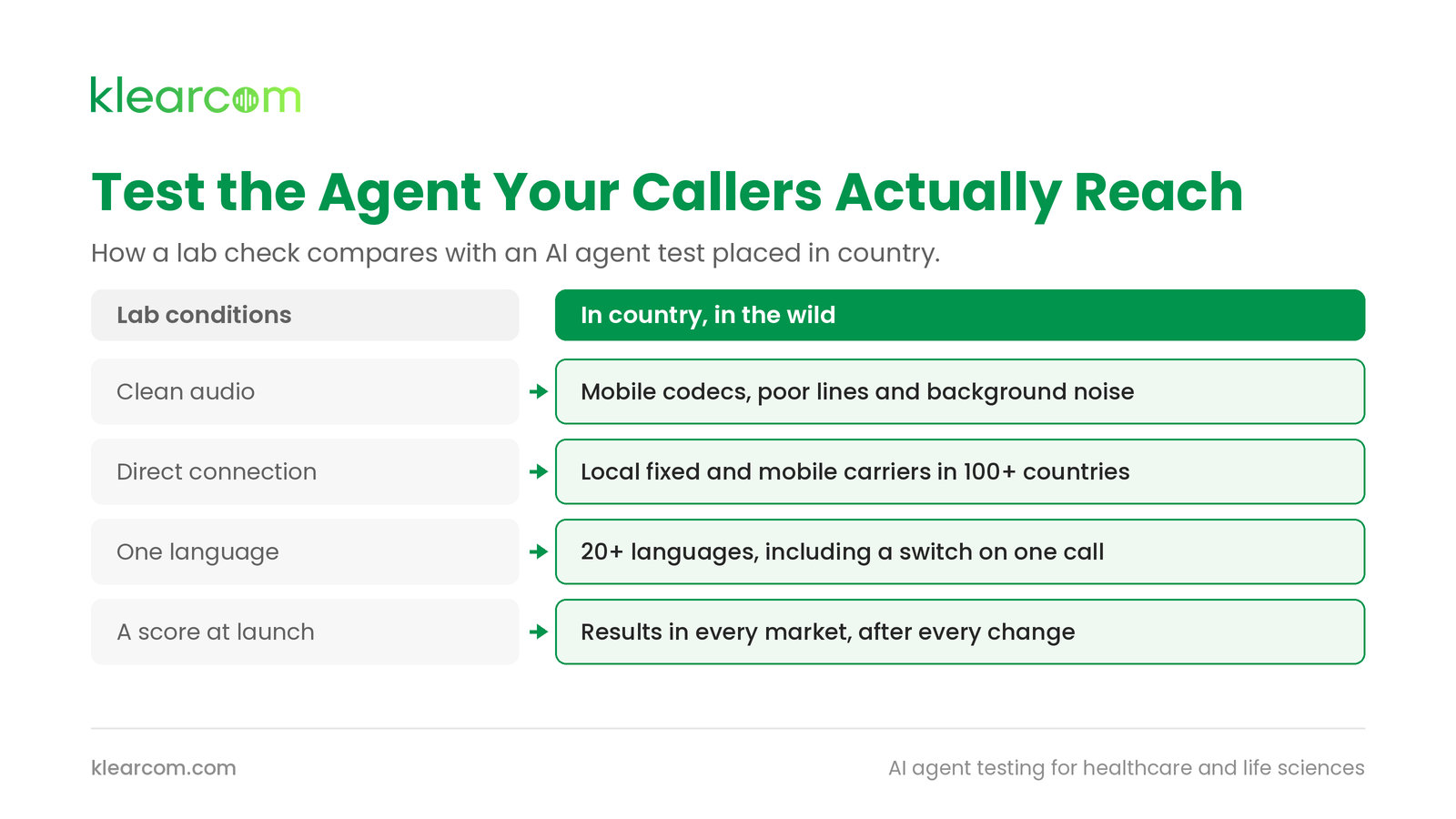
Every healthcare AI voice agent has two performance records. One comes from testing before launch: clean audio, a direct connection, a single language. The other comes from the first real calls in each country it serves. Most teams only ever look at the first.
The space between those records is where patients get misheard. A caregiver rings from a hospital corridor. A physician calls between procedures on a mobile with two bars of signal. A patient in Montreal starts in French and reaches for English to name a prescription.
The builders see this too. AssemblyAI's 2026 survey of voice agent builders found 75% struggle with technical reliability barriers, even though more than four in five say they feel confident building agents.
This guide sets out how healthcare and life sciences teams can test the deployed agent, market by market.
1. Place test calls from the caller's country
A test is only as realistic as the route it travels. Our callers are AI personas, much like the agents they test, but each one dials from inside the market over the same local fixed and mobile networks a patient would use.
That route shapes what the agent hears. Mobile networks compress voices, long carrier paths add delay, and weak signal strips away the detail speech recognition relies on. A test from a data center reproduces none of it.
We originate calls in more than 100 countries across 340+ carriers, and each one carries a local caller ID, so a carrier can trace it when something needs investigating.
2. Build a test set for each language
One deployment frequently covers several languages. A global medtech support desk we work with runs its virtual agent in all of its callers' languages, and another healthcare team serves North America and Europe, French Canadian included.
Give each language its own scenarios, accents and dialects, and write in the awkward cases: a patient who opens in Dutch and switches to English for a drug name, a regional accent the model rarely encountered, a product pronounced three different ways across three markets.
Clinical vocabulary raises the difficulty. A 2026 study in npj Digital Medicine found speech recognition made significantly more errors with non native English speakers reading clinical text, and dense medical terms caught out native speakers as well.
Include the AI disclosure in each set. Since 2 August 2026, interactive AI systems in the EU have had to make clear that people are talking to AI, with fines of up to €15 million or 3% of worldwide turnover, Help Net Security reports. Check the disclosure in each language whenever the agent changes.
3. Give quiet lines the same attention as busy ones
Some regional lines receive a few calls a day. On those lines, a single unanswered call is significant.
Few calls means long silences between them, so a broken journey can go unnoticed for hours, frequently overnight for the central team. Test on a timetable set by risk, independent of how busy the line is.
Cover local opening hours and the hours after closing, when different menus and recorded messages take over. The result is a near real time picture of every line, including the quiet ones.
4. Score audio as the caller hears it
A keypad menu only has to register a button press. A AI voice agent has to make sense of natural speech, so poor audio does more damage: a clear request arrives as noise, and the agent answers the wrong thing.
Measure audio on every test call over the real line, then break the results down by market, line and carrier. The people behind the agent often sit in different places too: in house centers, home offices and outsourced partners abroad.
At one organization, a faulty circuit at an offshore site produced around two weeks of poor calls before anyone found it. A trend line by site narrows that kind of search to one location quickly.
5. Confirm each transfer lands in the right language
When the agent hands over, the caller should reach a person who speaks their language, in that market's queue, with their details already on screen.
A broken transfer costs twice. The caller repeats everything, sometimes in a language they did not choose, at exactly the point they asked for a human.
Check transfers for every language and market, inside opening hours and after the local team has left, when calls should still reach an overflow queue or a callback option.
6. Know where a failed call broke
Two separate things happen when a test fails. First, you learn that something is wrong. Second, you work out which link in the chain caused it. The first is quick. The second takes evidence.
Every failure we report carries the recording, the time and the stage at fault, whether that is the carrier, the network, the contact center platform, the IVR or the agent. Carriers usually want several examples before they investigate, and this gives them exactly that.
There is a limit worth stating plainly. Dead air on a line can originate with the carrier or with a vendor, and the data does not always settle which. Our analysts repeat the call on other carriers and on mobile before raising an alert, which removes most of the doubt, though not all of it.
7. Track drift country by country
Agents shift between releases. A model update or new knowledge base content can correct an answer in German and quietly break the equivalent in Italian.
Hold a baseline of expected answers and transfers per market, rerun it after each change, and leave scheduled tests running in production. Drift often surfaces in one country first, and testing each market separately catches it there.
8. Write results for the whole team
Testing AI voice agents asks for more technical setup than the call testing that came before it. That is a design problem, and we treat it as one.
Engineers need control over scenarios, personas and scoring. Most of their colleagues need a plain check they can act on, for example whether the agent gives personal data to a caller who failed verification, with a pass or fail beside it. A good platform serves both groups.
Route alerts the same way: to the carrier team, the IVR team or the platform vendor, according to where the call broke, so each team member gets a result they can use without translation.
Test what patients actually reach
The agent your callers meet is the one running in their country, on their network, in their language. Klearcom's AI voice Agent Testing calls that agent from inside each market, so your results describe the user experience patients and physicians really get.
Talk to our team about testing your AI voice agent in every market you serve.