
Where wrong actions and abandoned calls hide in AI voice agent reporting, and how to find them.
Ask a software leader whether their product works and many will point to a low ticket count. I've learned to read that number the other way. Few tickets often means someone is doing the customer's work for them, so nothing gets logged.
Containment is the same number in a different jersey.
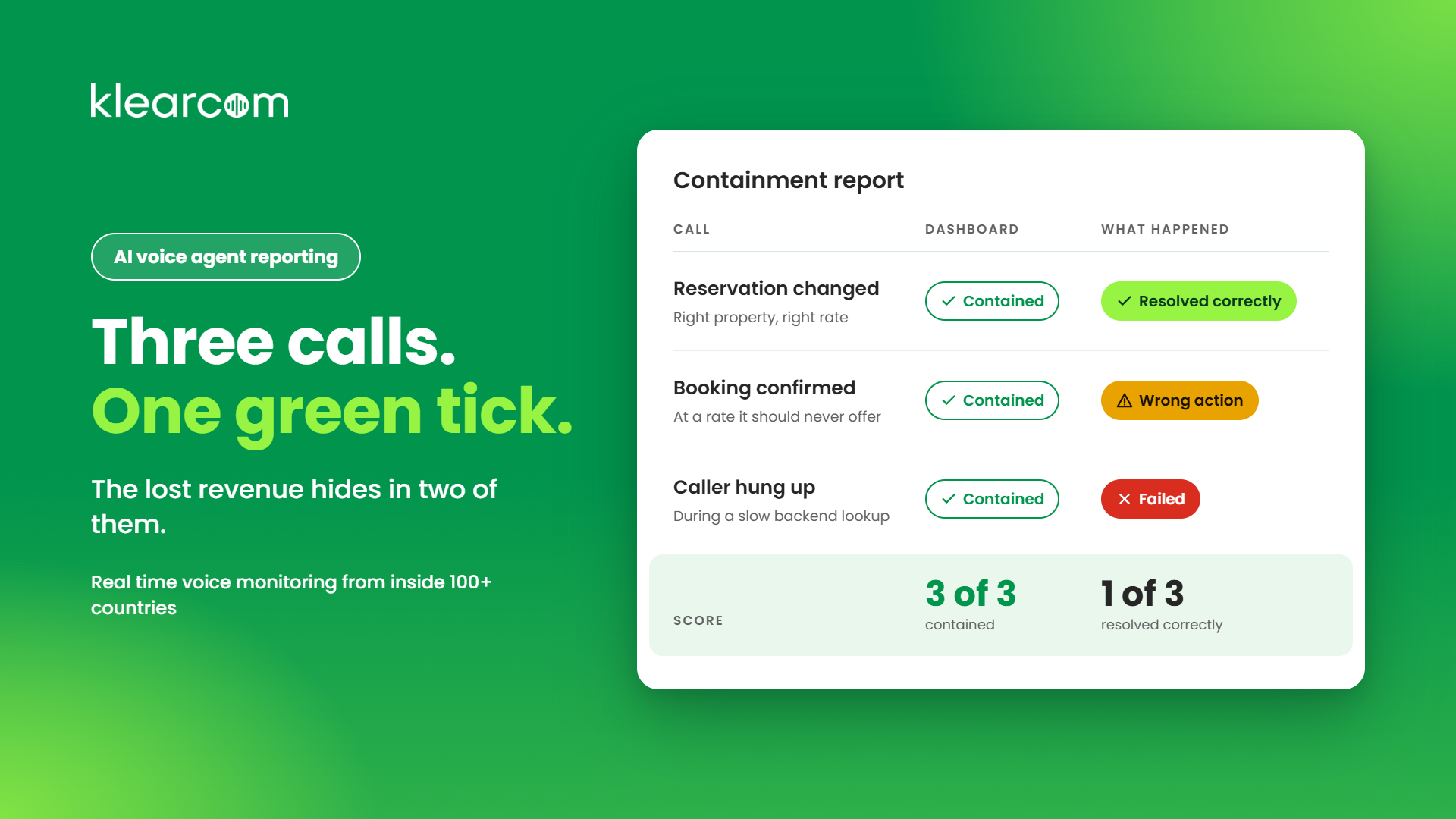
It's the share of calls an AI voice agent handles without a person, and it tops most AI voice agent dashboards. So what does it count? It’s things like a call the agent resolved, a call where it did the wrong thing, politely, and also a call where the customer gave up. All three get the same green tick, and no one is any the wiser.
Commonwealth Bank of Australia found out last year what that can cost. It cut 45 contact center roles after crediting its voice agent with taking 2,000 calls a week off the line. Call volumes kept climbing, team leaders were pulled onto the phones, and the bank reversed the cuts and apologized.
A contact center dashboard full of green ticks tells everyone what they want to hear. The lost revenue is in the other two calls: the one the AI voice agent got wrong, and the one where the customer gave up. This summer Gartner found a quarter of AI customer service projects lose money, and in 42% leaders can't say what they're getting back.
Customers count the cost even when the dashboard doesn't. Qualtrics XM Institute puts the sales at risk from bad experiences this year at nearly $3 trillion, with $973 billion of it in the US. Its research also found almost one in five people who used AI for customer support got nothing from it.
Wrong actions get filed as wins
We spoke with the testing team at a global hospitality business that's preparing to roll out an AI voice agent. Their pilot covered making, changing and canceling reservations, with guest counts, taxes and rate rules that differ by property. One risk they raised early: a caller talking the agent into a rate it should never offer.
How does that call report? Request understood. Booking made. Confirmation given. Caller happy. Contained, resolved, positive sentiment.
The margin left with the caller.
The same applies to a cancellation made on the wrong reservation, a refund approved outside policy. Each reads as a success in the transcript because the conversation sounded right. The damage sits in the booking engine, and in next quarter's revenue line.
Abandoned calls get filed as contained
A caller who hangs up on an AI voice agent rarely leaves a reason. Most reporting logs it as ended by the customer and, with no transfer attempted, counts it as contained.
A global manufacturer we spoke with this month runs its order care line, from order status to returns, with every call contained by design. It also means a caller who gives up during a slow backend lookup looks, in the data, much like one who got what they needed.
So why do callers leave? A second of silence on a local mobile route. Speech recognition that copes in one language and struggles in the next. An agent that never says it's an AI, when research covered by The Sociable found agents that introduced themselves as AI saw roughly 20% fewer hang ups. Average every market together and the leak disappears.
How to find the leak
Nobody would sign off a forecast that put won, lost and stalled deals in one column. Yet that's how most AI voice agent reports treat calls. Here's what I'd ask for.
- Grade each test call three ways: Resolved correctly, wrong action, failed. One pass rate hides two problems. Three numbers show you where the money goes.
- Score the outcome against the rule: Check each test call against what should have happened: the right rate, the right reservation, the right refund window. Do the same for compliance, from the authentication and data handling each market requires to the AI disclosure in every language the agent speaks. A wrong action there costs a fine as well as a sale.
- Break it down by market and journey: Look at failures by country, by language and by the point in the conversation where the call went wrong.
- Call from where your customers call: The carrier, the contact center platform and the AI provider each report on their own leg. Real calls placed inside each market over local carriers give you an independent record nobody in that chain has a stake in. Skip this and your customers end up as your monitoring system.
- Watch production in real time: Run those calls around the clock on the journeys carrying revenue and compliance risk, so any drift shows up the day it starts instead of months later.
The first report graded this way will look worse than the dashboard it replaces. Get comfortable with feeling uncomfortable.
The risk is yours, so watch it in real time
Liam Dunne, our CEO and cofounder, wrote recently about the fourth blind spot that comes with the contact center's fourth great migration, from IVRs to AI voice agents. Your carrier, your contact center platform, your AI provider and your own systems each see their own part. A call made in Germany can pass through data centers in France and Spain before the agent answers. Nobody sees the call from the customer's phone, and four healthy dashboards can sit on top of one broken journey.
The risk falls on one party: you. When an AI voice agent gets a call wrong, the customer blames your brand. Recently, a US pharmacy chain took its AI phone assistant off incoming calls after hundreds of complaints, including wrong dosage information. Since August, EU AI Act rules have required people to be told when they're talking to AI, and the deploying business is on the hook.
And the agent keeps changing. It can handle the same request two ways on back to back calls, and every update to its model or knowledge base changes how it behaves. A good launch is only day one.
This is where Klearcom is different. As a partner through the move to AI, we run real time voice monitoring: independent calls to your AI voice agent around the clock from inside 100+ countries across 340+ fixed and mobile carriers, checked against the commercial, risk and compliance rules you set. When a journey starts failing, you know the same day, with the recording and likely cause attached. A policy document says what the agent should do. A call from inside the market shows what it did.
Our AI Voice Agent Testing is open for early access in November, with limited places. If your agent is live or about to be rolled out, let's put a number on what it might be missing.