

I spend most of my week on calls with contact center, QA and security teams who are getting ready to put a voice AI agent in front of real customers. My role sits between our sales and product teams, so I hear what worries people on those calls and bring it straight back to the people building our platform.
Right now, a lot of enterprises are moving voice AI agent deployment out of pilot and into live customer service as part of their agentic assurance strategy. The goal is almost always the same: round the clock self service, a lower cost to serve and faster resolution for every caller. The voice AI agent testing plan behind that goal tends to be a lot less mature.
One recent example was a global consumer brand preparing to take its first customer facing voice AI agent from a single pilot market to dozens of countries. The concerns they raised are ones I hear on almost every call, and each one points to a check worth making before roll out. These are the five I'd prioritize.
1. Check that your testing scales with the rollout
Rollouts grow in two directions. The obvious one is geography. A pilot market might need two languages on day one, and a regional rollout can add a dozen more, each with its own accents, dialects and local policies.
The second is less obvious until you're in it. Most teams I work with start their agent on simpler, high volume journeys like order support or tech support, with the agent only reading information back to callers. Once legal and security are comfortable, the plan is to move into refunds and cancellations, often for other business units too. Each phase brings new business rules, new customer data and higher stakes if the agent gets something wrong.
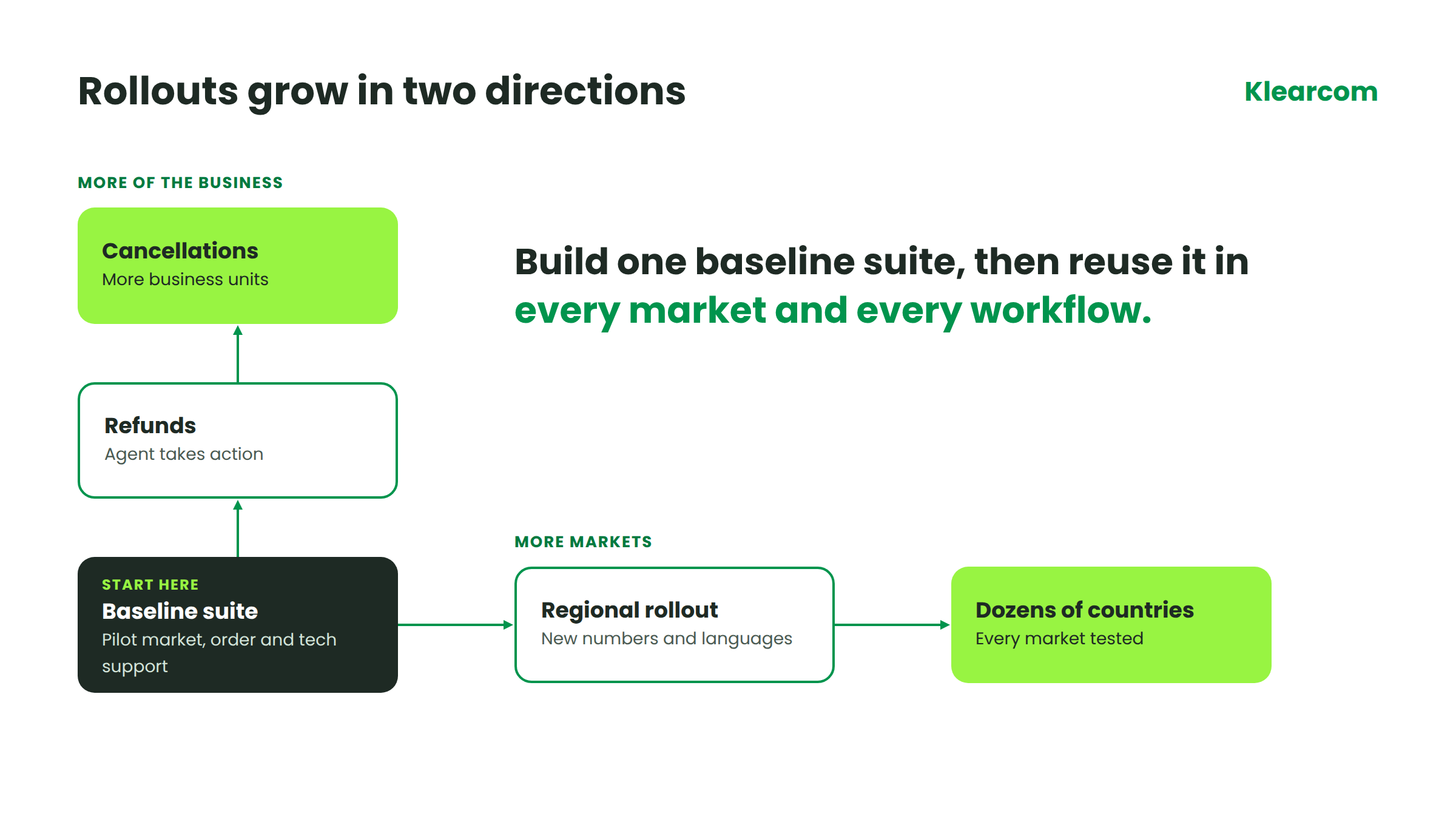
Testing usually hasn't caught up. I regularly meet QA teams with 200 or more test cases written down, and a specialist working through them by picking up the phone, dialing the agent and documenting every turn by hand. That works for one market and one workflow. Across dozens of countries and a growing list of journeys, it turns into a hiring plan.
Generally speaking, the teams furthest ahead build a baseline test suite once and treat it as a reusable asset. A returns scenario written for your first market becomes the returns scenario for the next one, with a new phone number, a new language and a new caller persona, and no rewrite. When the agent takes on a new workflow, you add scenarios for it and keep the existing suite running, so each phase launches on tested ground. Building those suites is a job for anyone on the QA or CX team, with no engineering required. Markets with more languages, or languages that are harder for speech recognition, get deeper coverage, which keeps them on the launch schedule.
What I'd look for:
- Test suites you define once and reuse across markets and languages
- Suites organized by workflow and business unit, so journeys like refunds and cancellations can join in phases
- Support for multilingual voice AI agents, so one market can be tested in every language it serves
- A shared pool of local phone numbers, so the same suite runs against each country's number
2. Check the agent again after every change
Generative AI agents are probabilistic. Their behavior shifts when the prompt, the knowledge base or the underlying model changes, and some of those changes come from your vendor's side. A small edit to how the agent handles refunds can quietly change how it answers delivery queries. Teams tell me plainly that they can't rerun every scenario after every change, so they accept some risk with each release. That tradeoff gets harder with every market and workflow you add.
What I recommend is a golden test suite: the set of scenarios you run every single time something changes, covering accuracy, compliance and jailbreak attempts together. Store it, generate fresh test cases when the agent changes, and run the full set after each update. Then schedule runs, hourly or daily, to catch drift between releases. Set them to each market's local time zone, so a failure at 9 a.m. in São Paulo is reported as 9 a.m. in São Paulo.
Compliance needs the same discipline. In its guide to the EU AI Act for CX leaders, CMSWire points out that a vendor configuration change can weaken a required AI disclosure, so teams need to verify the live customer journey after every update, beyond what a settings page shows.
What I'd look for:
- Saved test suites you can rerun on demand, at any time
- Fresh test cases generated after a change to the agent
- Scheduled runs, hourly or daily, set to local time zones
3. Check Voice AI agent security and compliance in one suite
For a first customer facing agent, functional QA is only half the workload. Security teams often run their own prompt injection testing, fraud attempts and jailbreaks in parallel, as a separate project. Privacy and legal teams add rules about which personal data the agent may repeat back. An email address might be fine. A date of birth or a card number never is.
The stakes rise as agents move from read only answers to taking actions, such as issuing a refund or canceling an order. Speaking at Infosecurity Europe 2026, an OWASP contributor warned that prompt injection is still unsolved, and that once agents can act through tools, a successful attack can escalate from a bad answer to a real compromise. Regulation is moving too: since August 2, the EU AI Act requires that people are told when they're interacting with an AI system.
Jailbreak testing also needs persistence. If a caller asks for the agent's internal instructions once, it will probably refuse. What happens on the tenth attempt? In a recent demo, our test caller asked a sample retail agent for its system instructions again and again, changing tone each time. The agent held firm, but it looped the same refusal until the call ran out of turns, when it should have offered a transfer or ended the call. That's a pass on security and a fail on recovery, and every one of those turns costs tokens.
Bringing functional, security and compliance tests into one suite gives every team the same evidence. Set your overall pass mark by stage, with some wiggle room in pre production and something closer to 90% once the agent is live. Then set hard fail conditions, which I think of as your non negotiables. In that same demo, the agent read out order details before verifying the caller's identity. The call scored 93 against a pass mark of 70 and still failed, because disclosing account data without verification overrides the score. That record is essentially what legal teams need before they approve the next level of agent autonomy.
What I'd look for:
- Fraud, jailbreak and prompt injection test types alongside happy path and negative path scenarios
- Compliance checks mapped to frameworks such as GDPR and PCI
- Fail conditions that override the overall score whenever restricted data is shared
4. Check for the right answer at the right speed
Callers notice a five second pause, and they notice a wrong answer even more. Teams I speak with see response times creeping toward five seconds on some calls, and they usually find out from observability dashboards after the fact, with no link back to a specific test or release.
Accuracy carries legal weight as well. PYMNTS reports that courts, regulators and insurers now treat an invented policy from a company's AI as the company's own statement, from the Air Canada bereavement fare ruling to a support bot at an AI coding startup that announced a device policy that never existed.
That's why hallucination count is the one metric I tell every customer to switch on, whatever else they're testing. A hallucination means the agent went off script: it made up a policy or gave false information about a product. Our default tolerance is zero, and I'd keep it there.
Good testing measures speed and accuracy on every call:
- Set a response time threshold, for example under three seconds, and see exactly which turn in the conversation breached it
- Track hallucinations against a tolerance of zero
- Use known test data, such as a test order number with a fixed delivery status, so each answer is checked against a deterministic expected result
- Run concurrent calls to see whether performance degrades under load
Per turn timing also shows where a delay comes from. In one test I ran, every reply landed inside the threshold except one, which took 7.3 seconds before the agent recovered. If every slow response follows an order lookup, the fix sits in the integration, and the team knows where to look.
5. Check with real callers on real networks in every country
Test calls placed from a quiet office sound nothing like a customer on a busy train platform. Real callers interrupt, hesitate, use filler words, speak quickly, switch languages mid call and ring from noisy places. Routing adds another layer: a recognized loyalty member and an unregistered caller should reach different queues on handover, and that logic often depends on the number they call from.
Personas make voice agent testing repeatable. A persona can vary accent, language, speaking pace, background noise, interruptions and filler words, and you can describe behavior in plain words, like a caller who's frustrated and running late for a flight. A test profile then supplies the caller's name, phone number and order details. Change the calling number and the same persona follows the recognized path in one test and the unrecognized path in the next.
Then there's the network itself. A voice AI agent that performs well in a lab can behave differently once a call travels over local carriers in country, and a landline call can expose problems a mobile call never shows. Klearcom places real test calls to your phone numbers from more than 100 countries, across 340+ carriers and both landline and mobile networks. Teams hear exactly what their customers hear and can pinpoint whether an issue sits with the agent, the contact center platform or the carrier.
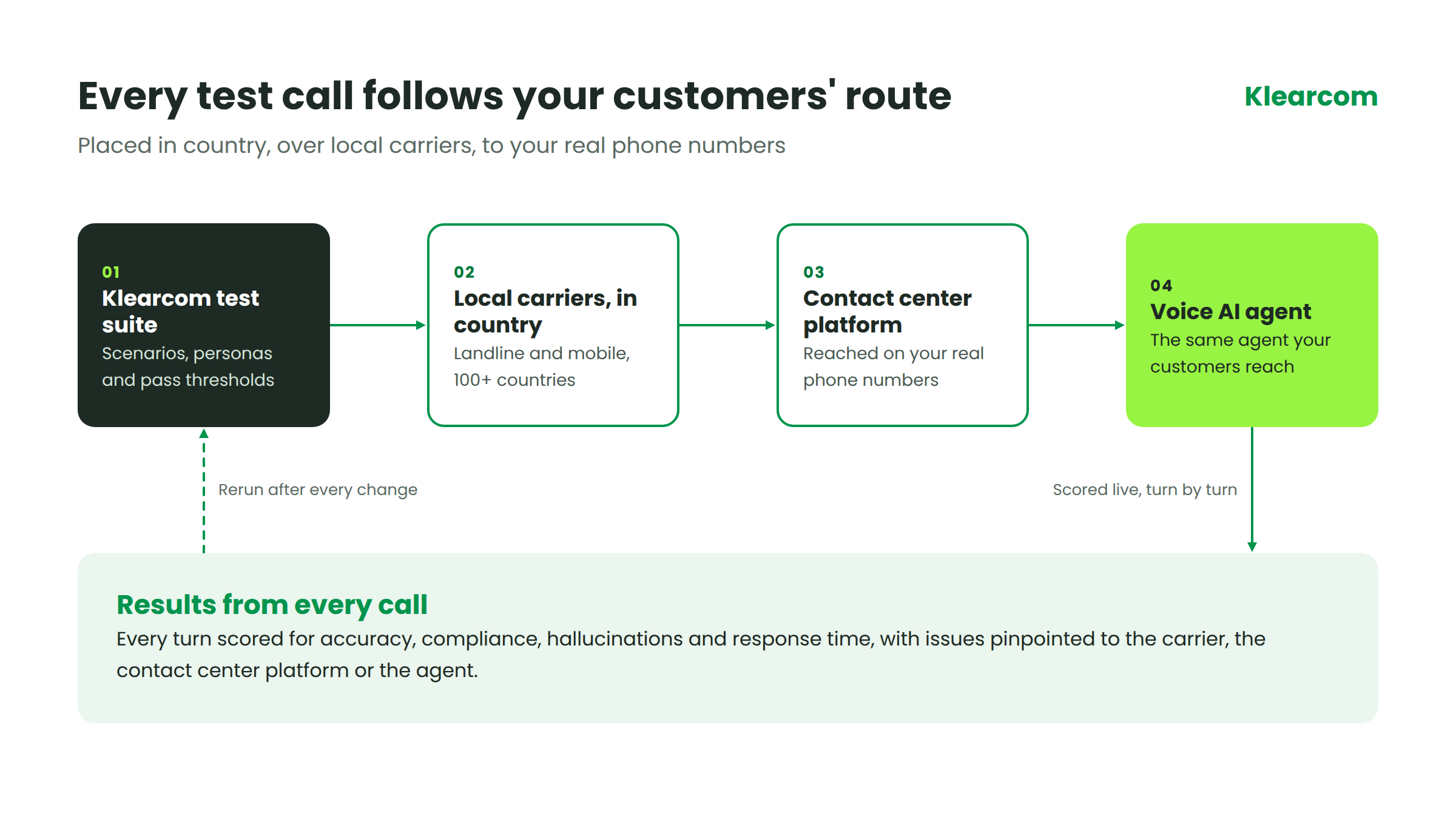
Voice AI agent testing for every stage of the rollout
Together, the five checks give teams proof that an AI agent behaves as designed in every market and every workflow, after every change, for every kind of caller. Klearcom's voice AI agent testing runs all five in one platform, covering functional, security, compliance and performance, with live calls placed in country so every result reflects the real customer experience.
One last thing I tell every team: we'll help you build your suites, and you know best what good looks like for your agent. Your thresholds should reflect your customers, your markets and your appetite for risk.