

By Tomas Piacek, Global Head of Business Development
Pharmaceutical companies have watched voice AI reshape customer service in other industries, and many are now weighing whether their patient and medical information numbers are up next for this agentic assurance transformation.
On one kind of number, the mood is cautious. When I reviewed proof of value results recently with a pharmaceutical company's patient services team, one of their leaders was clear: calls reporting side effects and product problems need trained people. Any automation near them has to be proven before it goes live, and I agree.
That caution should shape how voice AI agent testing works across the pharma contact center, where patient support calls are some of the most important customer experiences a company delivers.
Why safety numbers are different
Adverse event and medical information numbers sit inside pharmacovigilance obligations. A missed or mishandled call can mean an unreported adverse event, a corrective and preventive action (CAPA) and a difficult conversation with auditors.
The people calling are often worried, unwell or caring for someone who is. They may describe a reaction in everyday language, or mention it in passing during another request. Every one of those calls has to reach the right person.
Regulators are watching closely. In March, the FDA consolidated its adverse event databases into a single platform publishing reports in real time, as RAPS reported. In January, the FDA and EMA released ten guiding principles for good AI practice in drug development, Life Science Daily News reports.
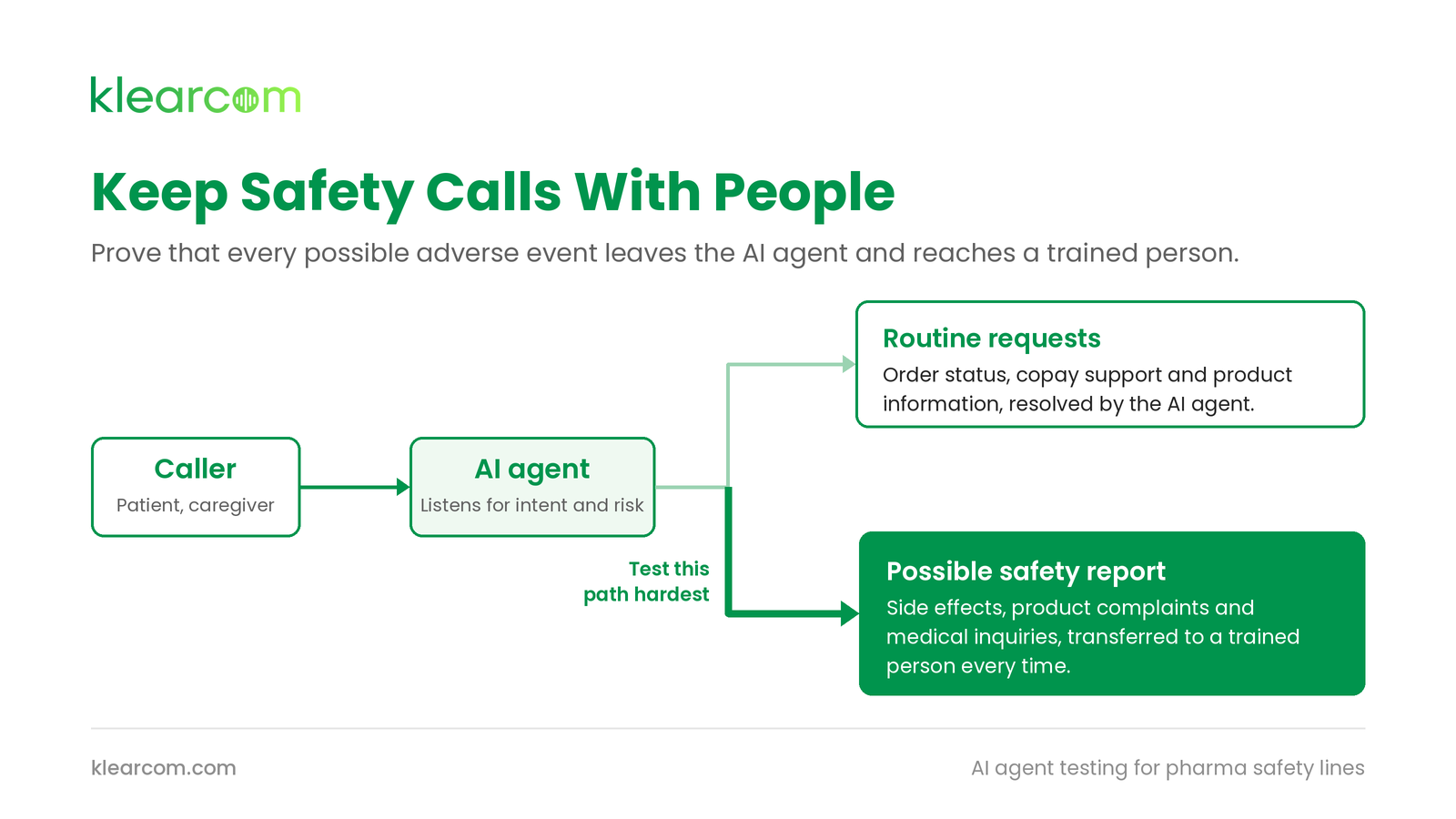
Keep people on the right path
The pattern I see most often is a hybrid. The voice AI agent handles routine requests such as order status, copay support or general product information. Anything that sounds like a side effect, a product complaint or a medical inquiry goes straight to a trained person.
That design only works if the routing works every time. I recommend testing it directly, with a focus on the edge cases:
-
Callers who describe side effects in plain, indirect language
-
Callers who mention a symptom halfway through an unrelated request, such as a refill
-
Accents, background noise and hesitant speech
-
Fail conditions that override the overall score whenever a possible adverse event is not escalated
-
Handoffs that reach the safety team's queue, during and outside business hours
Test what the Voice AI agent says on calls
Routine does not mean low risk. When a voice AI agent explains a copay program, its answers need to match approved information, and it must never drift into dosing advice or off label uses.
Build expected responses from the approved content your medical and legal teams already maintain, and set the tolerance for invented information at zero. Then push the agent with edge cases, such as a caller asking whether to double a missed dose, and expect a transfer to medical information every time.
Prevent unauthorized access to patient data
Patient support calls carry names, dates of birth, prescriptions and insurance details. A voice AI agent that looks up customer data must verify the caller first and share only what that caller is entitled to hear.
Test for unauthorized access the way a confused caller or a bad actor would attempt it: a wrong date of birth, someone claiming to be a caregiver, a request for another patient's order. Any disclosure should fail the test outright.
Use synthetic caller profiles so no real patient information ever enters a test call, and keep recordings encrypted for as long as your regulatory teams require.
Fax is still part of the safety path
Many pharmacovigilance teams still receive adverse event reports by fax, and those numbers fail without anyone being the wiser. One contact center team I spoke with discovered a fax number that had been failing for a month before anyone noticed.
Fax tone checks and test sends catch these failures without flooding sensitive mailboxes. Set test frequency per number, from every 15 minutes on the highest priority hotlines to daily on lower risk numbers.
Evidence that closes a CAPA
When a corrective and preventive action (CAPA) asks how the organization will catch the next failure sooner, continuous testing gives a concrete answer. Every test leaves a timestamped result, a call recording and the exact point where a call or fax failed.
Our test analyst team at Klearcom verifies each failure, retrying across carriers before raising a human verified alert, so contact center teams act on confirmed issues. Alerts arrive by email or through existing ticketing tools, with the findings attached.
Ready for the day AI reaches the safety number
Few pharma teams are putting voice AI agents on adverse event numbers today but are looking to test first before roll out, and I think that caution makes sense. The groundwork pays off: a tested baseline for every safety number, proof that routing works and a history of availability.
Start with the numbers that carry the most risk, test them in-country over the same networks your callers use, and expand automation only where the evidence supports it.