

Summary
At Genesys Xperience 2026, Klearcom spoke with over 250 contact center professionals. Six AI themes dominated: mainstream consumer adoption, involving staff early, treating AI agents as team members, building in compliance, starting with contained pilots, and planning transformation in phases. Here is what each means in practice.
In the coming years, a seamless AI experience will be an expected offering from the majority of enterprise brands. Helping customers solve problems, helping agents help customers, and actively helping businesses make smarter decisions.
The time of hype is over and the time of doing has begun. But where to start?
Last week we were in Las Vegas for the annual Genesys Xperience conference, where we spoke with over 250 contact center professionals and listened to many leading voices within the industry. The conversations at our booth had shifted from previous years. Almost nobody asked whether they should be deploying AI in the contact center. Nearly everyone asked how to do it without breaking something.
Here are six of the most common AI topics that came up during the conference, as well as ideas on how you can take them on.
Consumer adoption and comfort has evolved
At his fireside chat, Genesys CEO Tony Bates talked of a step change in how people are using AI within their personal lives. Its memory and understanding of context has got better, putting us at a crucial juncture for how we integrate it into our customer-facing processes. Tony was not the only person who made this observation, as the data backs it up too.
Recent Pew research shows that nearly half of U.S. adults now use AI chatbots, including over a quarter of people in the 50+ age bracket who were slower to adopt but are now growing.
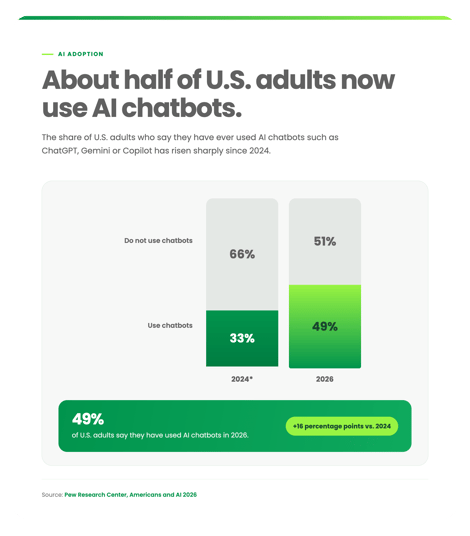
Source: Pew Research Center
As adoption grows, so too do expectations around how people can engage with the web. Consumers are now used to asking a nuanced question with multiple contextual interactions and receiving detailed, sourced answers. After this, simply being directed to an FAQ or being asked to sit in a queue for an hour feels outdated.
This growth in consumer comfort around AI tooling, combined with advances in performance and compliance guardrails, mean many brands are more confident about implementing an AI layer into their customer engagement.
Implement AI with contact center staff, not onto them
In his keynote speech, Genesys Chief Customer Officer Scott Cravotta highlighted that in a recent Genesys survey, contact center staff’s biggest hurdle for embracing AI was the fear that it would take their jobs.
However, he then pointed out a recent Gartner report highlighting that only 28% of staff had actually received proper information on how to understand AI. How can staff embrace the possibility of something they haven’t been shown the value of?
In a fireside chat, AXA’s group head of digital customer and distribution, Antimo Di Donato, suggested a way forward through these challenges by flipping this fear into opportunity. Take the time to work with your staff to explore how AI could help them serve their customers better, rather than giving them a lecture and a log-in.
“I admire my colleagues in the contact center, it’s a tough job where they need to show empathy to the caller in a difficult situation. But they also need to take practical steps to solve the caller’s problem, to do that they need to get the necessary data. AI makes this easier for them, surfacing an answer, checking data, and making a suggestion faster. This enables the human agent to focus more on giving them the empathy and help they need.”
Antimo Di Donato | Group Head of Digital Customer and Distribution, AXA
Re-imagining the workplace with AI as staff
Trying to shoehorn AI into a system built solely for humans means you won’t get the best out of either. Fresh approaches are needed that look at AI as a working resource, including how it is onboarded within the team, responsibilities, and handoffs.
- What is the AI’s job description and KPIs?
- How often is performance reviewed and functionality tested?
- What does training look like, both for humans and AI agents?
- What data or processes can the AI agent shadow and learn from before going live?
- Where does it sit on the team roster? This will help ensure it stays visible and useful.
- What’s the escalation process?
Compliance and guardrails are a bedrock of your AI experience
“Autonomy without trust isn’t enterprise AI.”
Tony Bates | CEO, Genesys
Just because an AI agent is handling a call, doesn’t mean HIPAA, GDPR, or your brand guidelines don’t apply. These need to be baked in as a non-negotiable, but how?
As a starting point, these are some of the suggestions of best practice that were mentioned throughout the conference:
- Establish clear, responsible governance on who is responsible
- Building agents specifically to check your other agents’ output through a compliance lens
- Rigorously test both pre-release and continuously once released to assess jailbreak, compliance, and brand guidelines
- Check local jurisdiction about AI usage disclosure
Think big, start small, and pick a contained pilot
A common topic of discussion we heard from conference attendees was around how to bring their AI experiences to life.
A key approach is to focus on smaller, self-contained projects in order to get things working and understood before a larger roll-out. Such things could include:
- Call transcription, which would be a starting point for many use cases
- Automated call categorization, for rapid cataloging and CRM enrichment
- Agent-assisted look-ups for relevant content or guides to help faster
- Supervisor insight on trends within their team
AI transformation is not a one-off, it’s continuous improvement
Across the several keynotes and case study talks, one theme was consistent. The results didn’t happen overnight. AI transformation projects started years ago and were still ongoing, but they all came with clear phases, goals, and a plan.
It’s also worth having a process in mind before you start implementing. For example, in our talk ‘Before the First "Hello": What Makes Agentic Voice Succeed’ Klearcom Chief Product Officer, Neil Weldon, introduced our simple 5-step process for testing AI voice agents.
If you’re interested in putting such a plan into action for your AI voice agent roll-out, you can download the one pager below.

.webp?width=168&height=29&name=Klearcom%20Logo%20-%20Name%20-%20Full%20Color%20Gradient%20-%20Footer%20(168%20x%2029px).webp "Klearcom Logo - Name - Full Color Gradient - Footer (168 x 29px)")