

SUMMARY
Adverse event phone calls fail where contact center dashboards can't see: carriers, speech recognition, handovers and AI agents. Test each line the way a patient would, and keep the evidence.
A patient in Portugal notices a side effect from new medication they are taking. She rings the local number on the leaflet and the menu asks her, in Portuguese, why she's calling. It can't make out her answer. After a second try, she hangs up. The manufacturer's safety team logs nothing. No case, no clock, no follow up.
I see this all the time. The number is live, the menu passed testing, every dashboard is green. They checked it all from the head office, but not from where the patient stood in their own country.
Why do phone calls matter so much in pharmacovigilance?
First, a note on process. Anyone having a severe reaction to a medicine should call emergency services straight away, on 112 across Europe or 911 in the US. The safety number printed on a leaflet is for reporting a suspected side effect, so the manufacturer can record it, assess it and pass it to regulators. Patients can also report through their doctor or pharmacist, or directly to their national regulator.
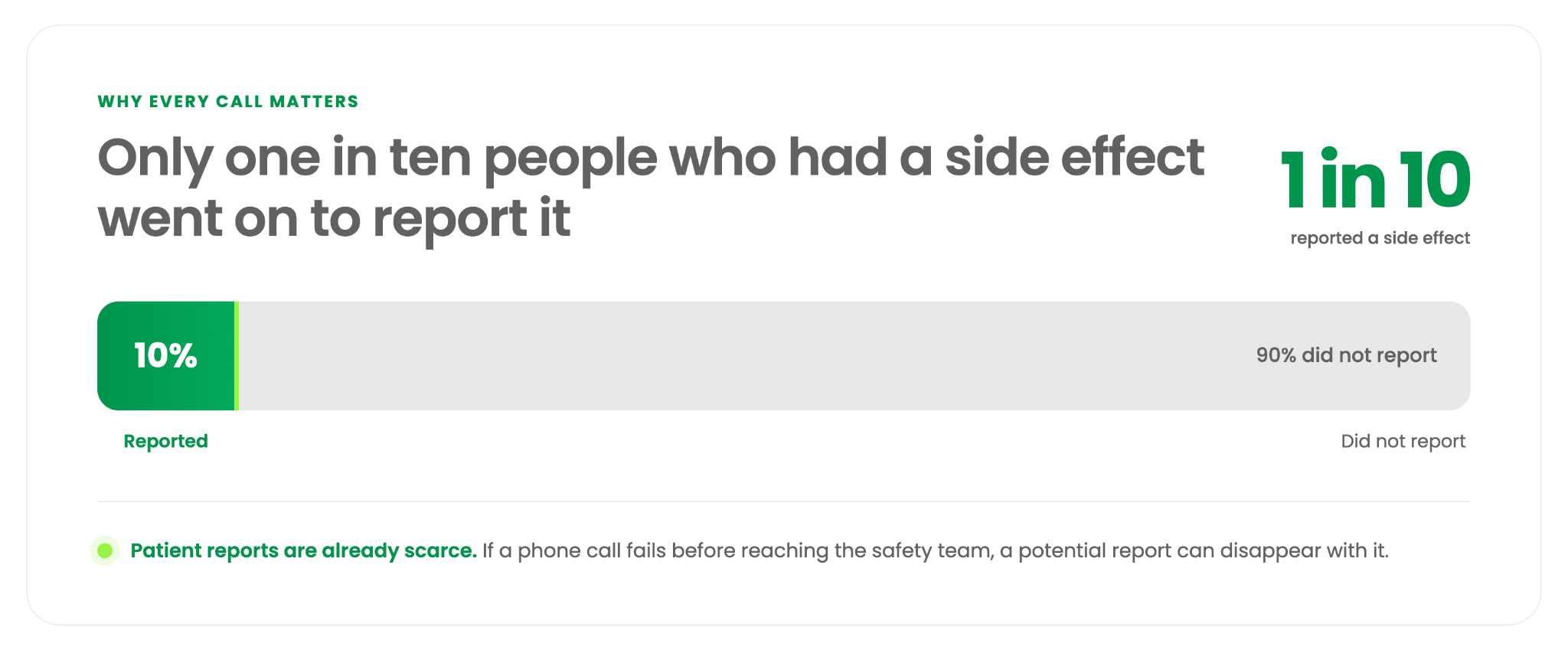
Patient reports are scarce across healthcare. A 2025 Healthcare Improvement Scotland survey found that only one in ten people who had a side effect from a medicine went on to report it.
EU guidelines require every suspected adverse reaction to be collected promptly, with serious cases reported within 15 days. The FDA gives manufacturers 15 calendar days from receiving a serious, unexpected case. If the call never connects, then the reporting clock never starts. The safety team never hears about it, so a warning that could have protected the next patient is lost.
Where do adverse event calls fail?
A number can be healthy in Germany and unreachable from one particular carrier in Poland on the same day. In my experience, failures come down to three places, each fine from the inside.
The number doesn't ring in that market
A toll free number or local phone number relies on carrier routing in each country, sometimes down to a specific area code. In our testing for enterprises, we saw one global pharma company's German adverse event line rang for 52 seconds, then played a "cannot connect" message. We explain in more detail here why international numbers fail country by country.
The menu or the agent doesn't understand the caller
Phone lines cut out part of the human voice, and that alone adds roughly 8 to 12 points to the error rate of automatic speech recognition. Accuracy of 95 to 98% in controlled conditions often falls to 85 to 92% on real calls, lower still with emotional speech and unfamiliar accents. Speech recognition systems tuned for routine customer service voice commands struggle with local brand names and everyday language. A menu that passed testing in English can loop a Greek or Polish caller until they give up.
More safety lines now answer with an AI agent instead of a menu. It lets a patient (like in this instance from Portugal) use her own words, but adds new ways to fail. The agent can mishear her on a bad line, miss a side effect mentioned in passing, or treat a frightened caller like a routine one. A carrier fault also looks exactly like an agent fault in the transcript, so teams rebuild the model while the carrier problem stays put. My colleague Neil Weldon explains how to tell the two apart.
The handover to a person breaks
Every handover, from out of hours routing to an outsourced safety center, is another place a call can drop. In a March 2026 warning letter, the FDA found a manufacturer's procedures didn't ensure it and its contractor reported serious cases on time. The contractor handled the call. The manufacturer answered for it.
AI agents add one more handover. If the report doesn't travel with the caller to a safety officer, she starts over, and some callers won't. The agent is the newest contractor on the line, and the manufacturer still answers for it.
What's the regulatory exposure?
At the MHRA's 2024 pharmacovigilance symposium, 27% of organizations surveyed already used AI for adverse event collection, before any AI system had faced an MHRA inspection. A dated record of test calls per market and agent version is what shows an inspector that your line, and the agent answering it, captured every report.
What changes when an AI agent answers the line?
Once an agent answers, the line changes more often as models update and carriers reroute, so we're extending the same outside in testing to AI agents. It checks more than 50 elements from real local numbers, including audio and service quality, compliance, accents and emotional speech, in more than 20 languages. It also tests the call the agent arrives on. Early access opens in November.
How do you make sure every patient call gets through?
KLEARCOM
That's what we do at Klearcom. We test voice channels as a patient would across more than 100 countries and 340+ carriers, AI agents included, and our analysts find the root cause of each fault before an alert reaches you. You get visibility into your voice estate without the legwork.
QUICK ANSWERS
Quick answers
Find out what your patients hear when they call to report a side effect.
Book a free consultation →or ask about early access to AI agent testing.
.webp?width=168&height=29&name=Klearcom%20Logo%20-%20Name%20-%20Full%20Color%20Gradient%20-%20Footer%20(168%20x%2029px).webp "Klearcom Logo - Name - Full Color Gradient - Footer (168 x 29px)")