
Summary
This week, many retailers will hand their busiest phone lines to AI voice agents. Most of those agents were tested by the vendors that built them, in conditions that look nothing like Black Friday weekend.
Peak is when an agent first meets real callers on real networks at real volume. The only dependable way to know it will cope is to call it the way your customers do, from the outside, before they do.
Retailers are giving AI agents their busiest calls of the year
Holiday returns lines used to mean an IVR menu and a queue. This year the voice on the other end is increasingly an AI agent that can look up an order, issue a refund and change a delivery without a person involved. Talkdesk's 2026 AI Holiday Shopping Survey of US retail leaders found that 93% of AI-using retailers will deploy AI agents in customer service this season, and 51% of them plan to have those agents complete returns, refunds or exchanges.
That changes what a failed call means. A broken menu option sends a caller to the wrong queue. A broken agent can move money.
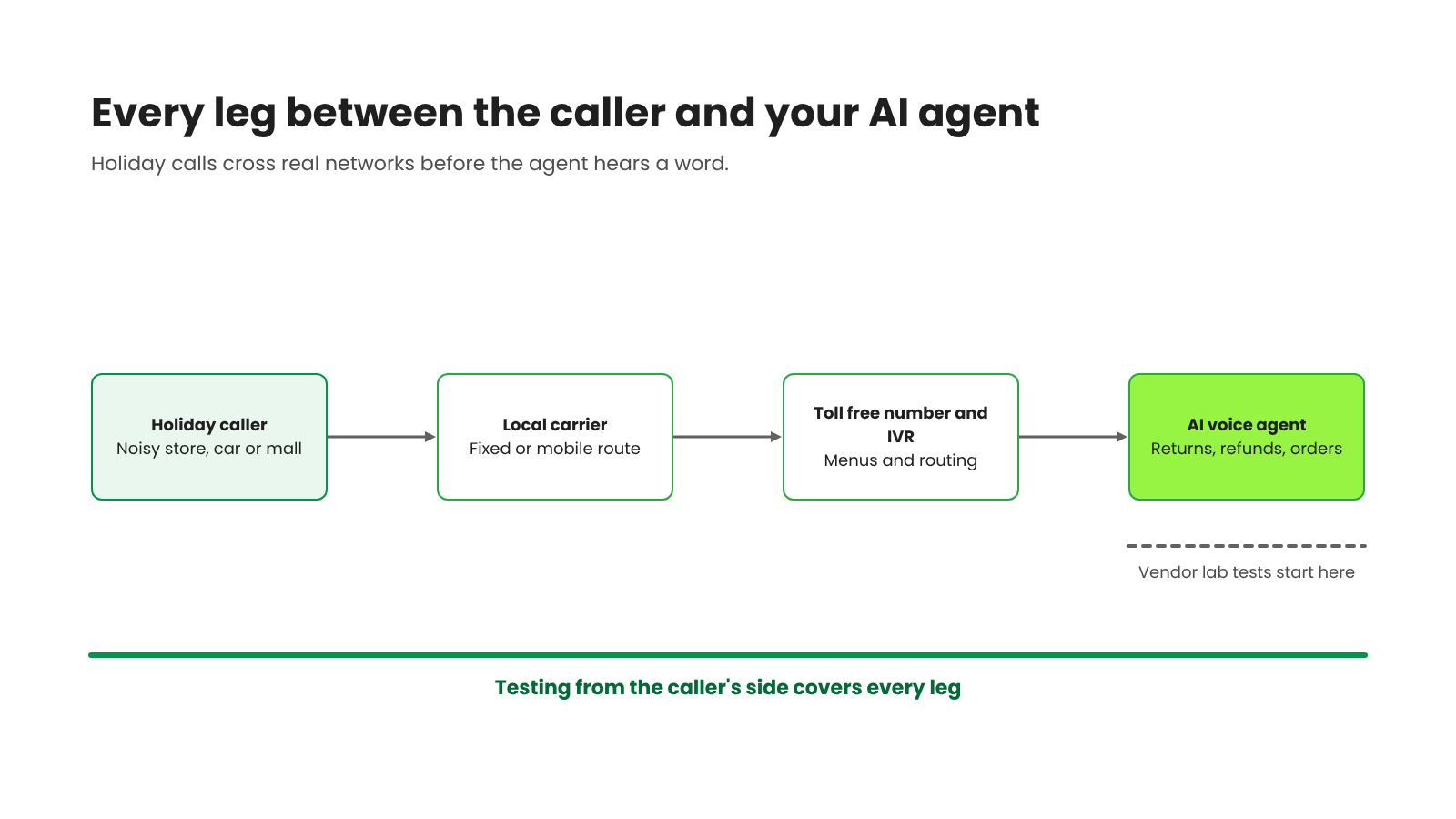
The agent also sits behind the same toll free numbers, carrier routes and IVR as everything else. It inherits every problem on the path to it, then adds its own.
Holiday callers don't sound like the lab
Vendor benchmarks are usually built on clean audio, direct connections and scripted callers. Holiday shoppers call from a mall parking lot, a checkout line or a car on the interstate with the kids in the back. Their calls arrive over local fixed and mobile carriers the lab never touched. They interrupt, hesitate, change their minds halfway through a sentence and switch between speaking and pressing keys.
They also arrive all at once. Aircall notes that businesses can receive double or even triple their usual inbound call volume during peaks like the holidays, which raises the load on the agent, the integrations behind it and the routes into it together.
This is the gap Agentic Assurance is built for. AI personas call your deployed agent over real networks with real accents, background noise, interruptions, emotion shifts and speech pace from 0.5x to 2x, in 20+ languages. Every failure is traced to audio, telephony, intent or answer, so you know whether to call the carrier, the AI provider or your own team. Load Testing then shows whether the IVR in front of the agent holds up at peak volumes, so you see December traffic before your customers create it.
A wrong refund lands on the brand
When an agent misunderstands a caller, the transcript can look perfectly reasonable. The agent heard "return," found an order and issued a refund. It just picked the wrong order, or refunded an item the caller wanted to exchange.
Talkdesk found that 31% of AI-using retailers say their AI took an action on a customer's account that it shouldn't have, such as a wrong refund or an incorrect order change. Among retailers whose AI caused at least one problem, 29% lost a customer as a result.
The shopper doesn't separate the AI vendor from the retailer. They dialed your number, so your brand made the mistake.
Agentic Assurance scores every test conversation against your own risk, compliance and service rules. Each test records what the caller asked, what the agent said and what it did in your systems, by market and carrier. Built in tests for jailbreaks, data privacy and hallucinations matter more once an agent can touch payments, and PCI DSS is among the frameworks covered. You go into peak with evidence of how the agent handles refund and exchange calls instead of learning it from complaints.
The way out to a person has to survive the rush
An escalation path is part of the agent, and it needs testing just as hard. In the same Talkdesk survey, 48% of shoppers said they worry they could get stuck with no way to reach a human to fix a problem.
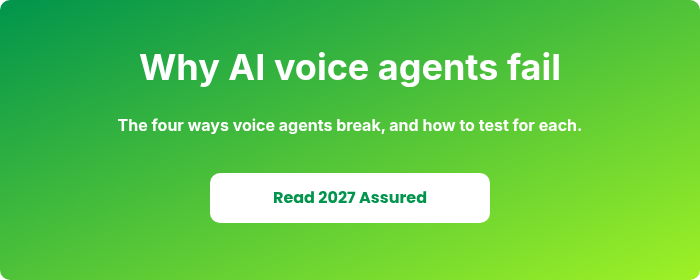
Shopify's Cyber Monday outage in 2025 showed how that happens. The Logic reported that some merchants locked out of the backend for hours couldn't reach human support either, because contacting support depended on the same system that wasn't working. Voice agents can fail the same way. If the transfer to a live agent relies on the platform, integration or route that is struggling, the caller loses the agent and the person together.
So test the handoff from the outside. Ask for a person in every market, over each carrier, under load, and confirm the call lands in the right queue with someone to answer it. Production Monitoring calls your numbers, IVRs and routes on a schedule from inside every country in the world over 340+ fixed and mobile carriers. Failed calls are retested and verified in country before anyone is alerted, and the alert names the failing leg: carrier, in country route, IVR or queue. Because it calls over the phone network, it keeps working when the system it is checking does not.
Test before peak, watch during it, keep going through January
Every party on the call reports on its own piece. The AI provider reports the agent's metrics, the contact center platform reports its queues and the carrier reports its network. Each dashboard can show green while a caller in Ohio hears silence after the greeting.
We have spent years calling numbers and IVRs from the caller's side, and the pattern holds for AI agents too. Most voice failures are silent, partial, regional or carrier specific. They sit outside platform dashboards and surface when real customers start calling.
Before peak, put the agent through realistic callers and realistic volume, starting with refund and exchange flows.
During peak, keep testing the live agent, because models, prompts, knowledge and carrier routes keep changing, and an agent that passed in October can drift by mid December.
After the holidays, stay on it through the January returns wave, when refund calls dominate and the agent is making financial decisions at scale.
Doing this from one independent record, by country and carrier, gives every supplier the same evidence to answer to. For a broader look at how AI voice agents fail in production, see what makes agentic voice succeed.